
From iPhone Revolution to AI Fatigue: Why Tech Excitement Is Fading (And the Best Post-Prime Day Deals Still Worth Grabbing in 2026)
Smartphone
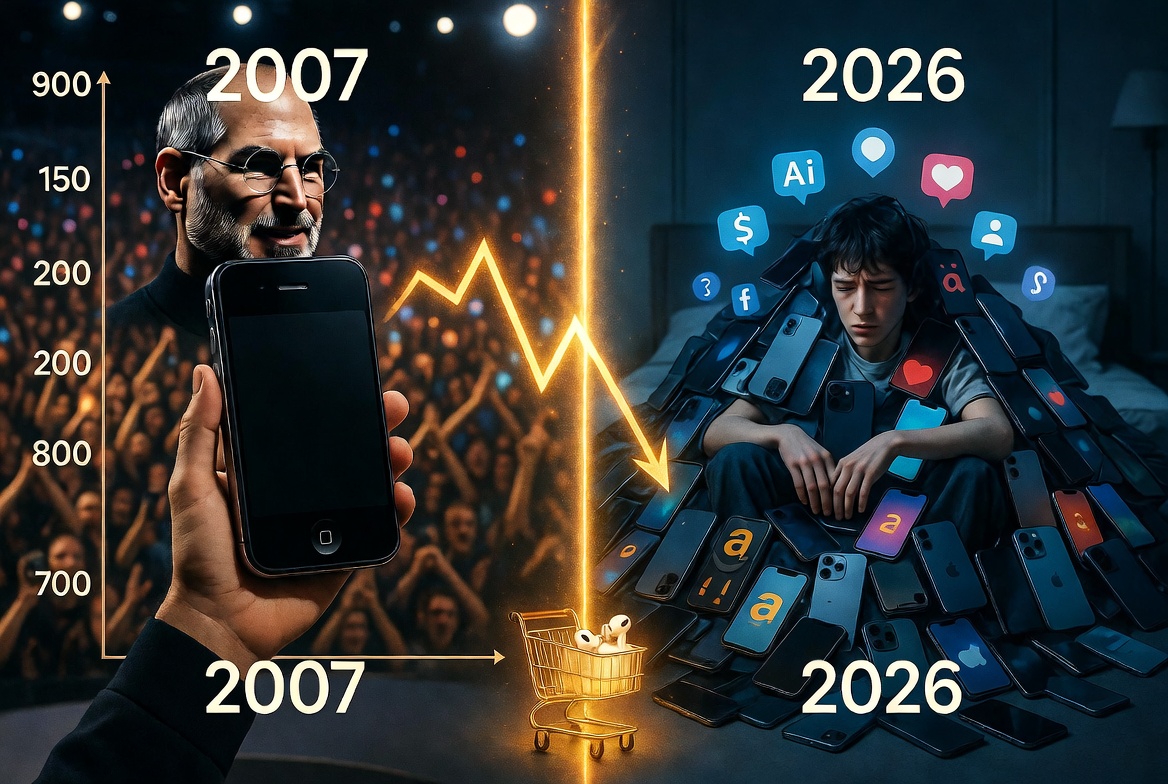
The pinnacle of tech enthusiasm reached its high-water mark on January 9, 2007, at 9:41 AM PST, the precise moment Apple CEO Steve Jobs unveiled the revolutionary iPhone to the world.
Cell phones weren’t new—neither were cellphones with touch screens—but this one was profoundly different: so high-tech it seemed unreal, yet so perfectly designed it felt utterly inevitable. Excitement surged far beyond tech nerds—everyday people felt it too. At the 2007 Macworld Conference & Expo, the crowd erupted into rapturous applause when Jobs demonstrated the iPhone’s multi-touch—an ovation for a mere software feature!—because it felt like he was literally touching a better future.
People proclaimed the iPhone was straight out of Star Trek. But unlike fictional communicators or tri-corders, it was obtainable (if you had $500) proof of a future where technology would finally liberate us from life’s drudgery, so we could boldly go—wherever, it doesn’t matter.
The iPhone, people said, was like something out of Star Trek. But unlike communicators or tri-corders, it was obtainable (if you had $500) evidence of a future where technology would finally free us from the drudgery of our lives so we could boldly go—wherever, it doesn’t matter.
Where Does True Tech Excitement Come From?
Visionary startup leaders love to ramble about “paradigm shifts” and “world-changing technology,” but consumers rarely get hyped for products promising to cure cancer. For most pampered Western lives, daily existence involves routine annoyances—and tech’s real appeal lies in eliminating them. Remember printing MapQuest directions before heading out? Total pain. The iPhone ignited excitement by solving the MapQuest problem plus countless small, intimate frustrations like “I can’t instantly send a photo to my friend” or “I get bored while riding the bus.” Products that truly solve these thrive; failures get tossed aside like a Juicero.
It’s impossible to overstate how brilliantly the 2007 iPhone addressed everyday annoyances. Owning one meant ditching the notepad, camera, laptop, MP3 player, GPS device, flashlight, and alarm clock—all crammed into one sleek black mirror. But speaking of black mirror…
From Peak Excitement to Growing Boredom
“We’re in an era of incremental updates, not industry-defining breakthroughs,” notes Heather Sliwinski, founder of tech PR firm Changemaker Communications. “Today’s new iPhone offers a slightly better camera, marginally different dimensions or AI features that no one is asking for. Those aren’t updates that go viral or justify consumers shelling out thousands of dollars for a device that’s only slightly better than what they already own.”
Economics defines “marginal utility” as the extra satisfaction from one more unit of a good. The leap from flip phone to the first iPhone delivered massive utility. But the law of diminishing marginal utility applies: each successive iPhone release yields progressively less added satisfaction. Slightly faster chips, slightly better cameras, USB-C instead of Lightning, titanium instead of aluminum—who cares?
Boredom alone would be manageable. Yet increasingly, devices once desired to simplify and enhance life are complicating it and making it worse.
The Growing Technological Hassle
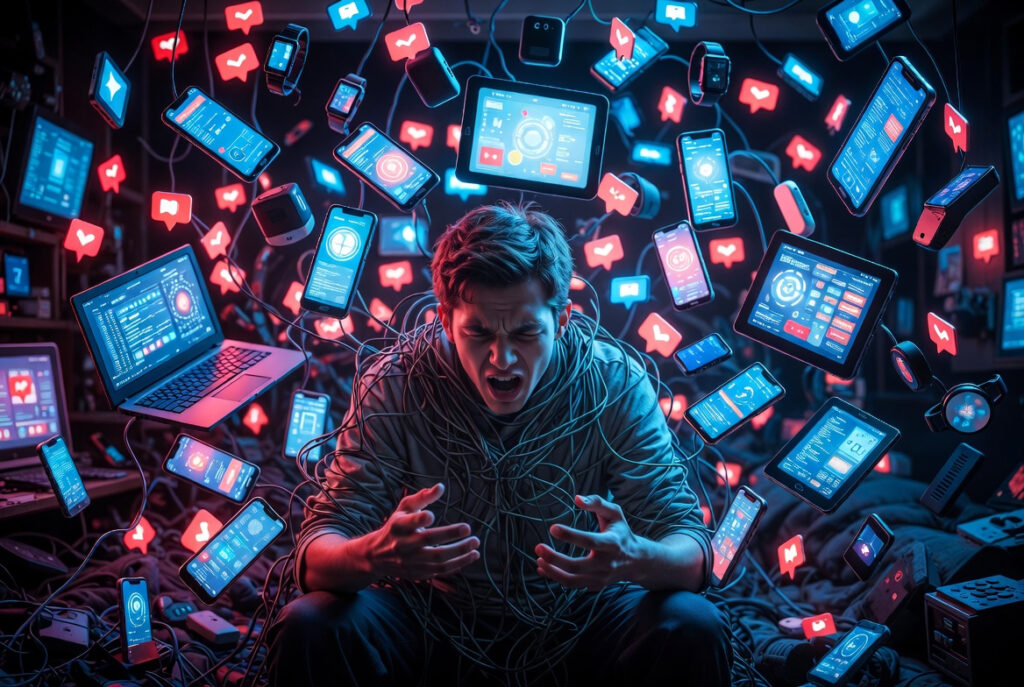
“When you buy a new tech product today, you’re not just buying one physical product. You’re committing to downloading another app, creating another account and managing another subscription,” Sliwinski explains. “Consumers are exhausted by the endless management that comes with each new device.”
The door refused to open. It said, “Five cents, please.” He searched his pockets. No more coins; nothing. “I’ll pay you tomorrow,” he told the door. ― Philip K. Dick, Ubik
“Corporations have spent years trying to manufacture excitement around relatively low-importance features instead of genuinely useful developments, and consumers have learned to recognize that pattern,” says Kaveh Vahdat, founder of RiseOpp, a Fractional CMO and SEO firm based in San Francisco.
Consumer indifference peaks with AI. “Consumers are testing Sora or testing Grok and all of that, but there’s really not been a single use case or product for AI that I think consumers are excited about,” Sliwinski observes.
Tech companies won’t stop pushing. Even without genuine excitement, artificial intelligence infiltrates everything—from toothbrushes to baby strollers (PKD would find the AI stroller darkly funny: it’s self-driving, but it won’t work if you put a baby in it.) “There’s a lot of buzz around AI but we’re missing the ‘so what?'”
Shifting from Indifference to Dread
Beyond “so what?”, consumers now ask: “How will this hurt me?” “Is AI going to encourage my child to take their own life? Is it going to steal my job? Is it destroying everything pure about humanity?”
Tech giants show no signs of scaling back AI or effectively communicating benefits. If they can’t ease life, history suggests they’ll trap us instead—hiring psychologists, neuroscientists, and “growth hackers” to engineer addiction via variable reward schedules, social validation metrics, parasocial relationships, and other dark patterns. Innovation shifts from life-improving products to addiction mechanics, until we resemble Ubik‘s half-lifers: husks in cryopods, trapped in manufactured reality still paying for doors to open. That’s the PKD perspective.
“Maybe 10 to 20 years down the road we will have another huge step change like the iPhone that can condense all these different devices that we’re using or apps that we’re using —but the tech isn’t there yet,” Sliwinski concludes.
In Star Trek, humanity doesn’t simply abandon scarcity—technology renders it indefensible, but only after a planet-wide war. From a Roddenberry viewpoint, enshittification occurs when outdated economic systems cling to survival as technology erodes their rationale. Each “I don’t care” incremental tweak pushes us closer to Star Trek‘s utopia of holodecks, abundance, and hot aliens.
Lingering Tech Deals After Amazon’s October Prime Big Deal Days
Amazon’s Big Deal Days (October 7–8, 2025) has ended, but many strong tech deals from the event persist into 2026, with prices often holding steady or adjusting slightly. While some devices have seen minor price shifts, significant savings remain on proven Apple products, smartwatches, audio gear, and more—ideal for upgrades without waiting for the next major sale.
Focus on standout recommendations in tablets (iPads and e-readers), smartwatches, headphones, storage, and console games.
Best iPad and E-Reader Deals
- iPad (A16): $279 at Amazon (was $349) — The best iPad for most people at a fantastic price; grab the 11-inch model as low as $279, or upgrade to 256GB at $379 (16% off) for future-proof storage.
- iPad mini: $399 at Amazon (was $499) — My favorite Apple iPad for its fun, compact power; snag it as low as $379, or go for 256GB at $499 (down from $599).
- Boox Palma 2: $269.99 at Amazon (was $299.99) — Premium e-reader blending Android flexibility with e-ink; perfect for focused reading without smartphone distractions.
Top Smartwatch Deals
- Apple Watch Series 10: $359 at Amazon (was $429) — Excellent last-gen model; skip hypertension alerts and 5G for big savings.
- Apple Watch SE (2nd Gen): $179.99 at Amazon (was $249) — Ideal simple Apple Watch for core features at a steal.
- Pixel Watch 3 (41mm): $199.99 at Amazon (was $249.99) — Great Android/Pixel companion; Wi-Fi models $50 off, LTE up to $80 off.
- Galaxy Watch 7 (40mm): $140.99 at Amazon (was $249.99) — Massive discount on capable Samsung watch for workouts and notifications.
- Garmin Venu X1: $699.99 at Amazon (was $799.99) — First-time sale on premium fitness tracker rivaling Apple Watch Ultra.
Premium Audio Deals
- AirPods Pro 2: $169.99 at Amazon (was $249) — Still excellent in 2025 with top ANC and Apple integration.
- AirPods 4: $89 at Amazon (was $129) — Budget entry at 31% off; ANC version $119 (34% off).
- Google Pixel Buds Pro 2: $189 at Amazon (was $229) — Strong ANC for Android users.
- AirPods Max (USB-C): $429 at Amazon (was $549) — Fantastic over-ear for Apple ecosystem fans.
- Sony WH-1000XM4 Headphones: $188 at Amazon (was $348) — Outstanding non-Apple ANC choice.
- Bose QuietComfort Bluetooth Headphones: $229 at Amazon (was $359) — Premium Bose-level noise cancellation.
Storage and Gaming Deals
- WD Black 2TB SSD for PS5: $180.49 at Amazon (was $251.99) — Essential 2TB expansion (28% off); options for 1TB–8TB available.
Ongoing console game savings include:
- The Legend of Zelda: Tears of the Kingdom (Nintendo Switch): $57.50 at Amazon (was $69.99).
- Super Mario Odyssey (Nintendo Switch): $51.90 at Amazon (was $59.99).
- Death Stranding 2: On the Beach (PS5): $49.99 at Amazon (was $69.99).
- Elden Ring (PS5/PS4/Xbox): From $26.58–$29.99.
- God of War Ragnarok (PS5): $29.83 at Amazon (was $69.99).
- Returnal (PS5): $29.99 at Amazon (was $69.99).
- Horizon Forbidden West (PS5): $29.83 at Amazon (was $69.99).
- Split Fiction (Xbox): $34.99 at Amazon (was $49.99).
Extend your hunt to competitors: Walmart (October 6–12 deals up to 50% off, great with Walmart+), Best Buy (through October 12, excellent for My Best Buy members), and Target (through October 11, up to 50% off with free Circle membership).
The original iPhone captured hearts by genuinely simplifying life. Today’s tech landscape challenges companies to recapture that magic amid incrementalism, hassle, and unease—while smart shoppers seize remaining value from past events.